Flexible for Any
Classroom Size
Classroom Games
Additional Rules
& Gameplay Ideas
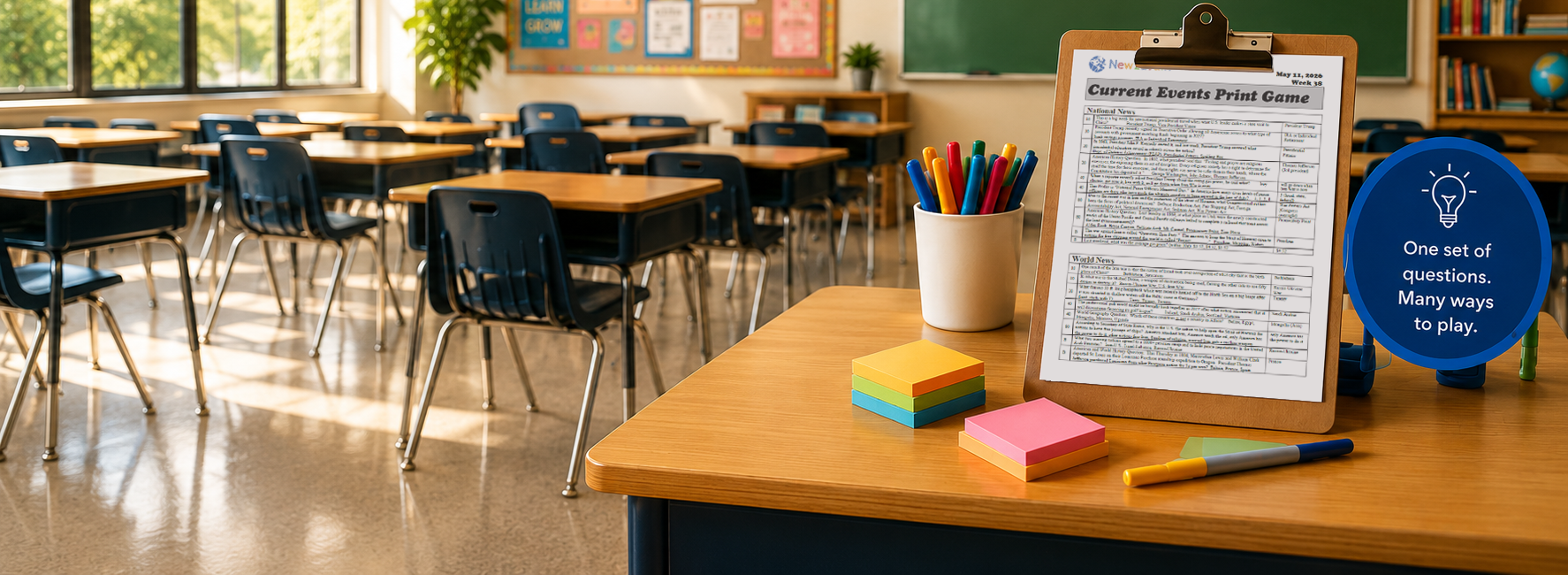
NewzBrain offers multiple ways to turn the weekly print questions into 5- to 45-minute classroom games.
5 to 45 Minutes
of Play
Multiple Ways
to Play
1
NewzBrain Wash
Fast, simple, and great for any class period.
- Divide the class into two to four teams with captains.
- Each question is worth one tally, regardless of printed point value.
- Save bonus questions until the end, where a wash question can decide the winner.
- Teams answer four questions from one category, and missed questions can be stolen by the next team.
- If tallies are tied, use run-off questions. If one team leads, use a bonus wash question to determine the final winner.
- Divide the class into two to four teams with captains.
- Flip a coin to see which team goes first.
- Teacher reads four questions from the same category to Team 1. If Team 1 answers all four correctly, they earn four tallies. If Team 1 misses, Team 2 can immediately answer correctly to gain the tally. If Team 2 misses, Team 3 can gain the tally, and so on.
- After Team 1 is finished, the teacher reads four questions from another category to Team 2. If Team 2 answers all four correctly, they gain four tallies. If Team 2 misses any, the next team can answer correctly to gain that tally.
- When playing wash, every question is worth one tally regardless of the printed point value.
- Bonus questions must be saved for the end of the game when the "Wash Question" determines the winner.
- After round one ends, compare the tally points. If teams are tied, continue with two run-off questions for the tied teams.
- If one team leads after round one, that team earns the right to answer a bonus "Wash Question." The teacher may choose any category from the NewzBrain Weekly game, or let the trailing team choose the wash category. If the leading team misses, the next-leading team can answer and be declared the winner.
2
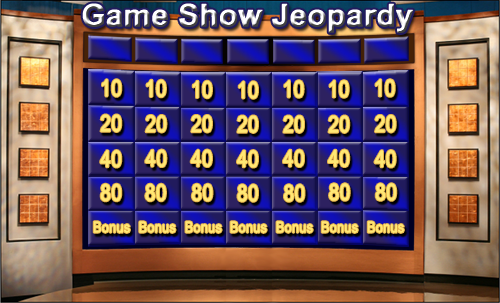
Game Show Jeopardy
Classic game show excitement for the classroom.
- Divide students into teams of 4-6 and have each team pick a captain.
- The captain chooses the first question and is the spokesperson for the team's answer.
- Teams take turns choosing categories and point values, with steals going clockwise if a team misses.
- Teachers can make 80-point questions optional or add choices when needed.
- Bonus rounds can be used at the end to decide the game.
- Divide the students into groups of four to six. Each team selects a captain.
- The captain asks for the team's first question, rotates category picks around the group, and serves as the spokesperson who gives the official answer to the teacher.
- The game begins with the captain of Team 1 asking for a category and point total question. Allow a reasonable amount of time to answer. If the answer is wrong, Team 2 can steal the points if their captain gives the correct answer. If Team 2 is wrong, it then goes to Team 3 to steal the points.
- The next question of the game is asked by the captain of Team 2. When Team 3 has asked a question, Round 1 is over. Round 2 begins when the person sitting clockwise to the Team 2 captain asks for a new question.
- This is different from TV Jeopardy because the team that answers correctly does not always get the next question. A team may steal points and still wait for its normal turn to pick next.
- Ten to fifteen minutes before time is up, and after Team 3 has asked the question that ends the round, call out the last round of regulation.
- Announce the score after each regulation round.
- Bonus questions are worth 200 points each. During the bonus round, all other students should stay quiet while the team gets its questions. Bonus questions are read one after the other, and there is no stealing in the bonus round.
- Teachers may find the 80-point questions too difficult and may choose to use them for another activity, or add answer choices to make them easier.
- Depending on reading level, students may be the readers for the game. This gives students ownership and gives the teacher a break.
- When the last regulation round is over, read the point totals. The team behind gets first choice of bonus category, the team in second place must choose a different category, and the leaders choose last.
- Another way to play the bonus round is to have the team behind pick the bonus category for the team ahead.

3
Las Vegas NewzBrain
High stakes, big points, and lots of excitement.
- Teams wager half the point value of the question they request.
- Correct answers earn the full amount; misses subtract the wager.
- Teachers can add the 'Lucky Lady Option' where a team may pass after hearing a question and give the rest of the class a chance to gain half the value.
- Divide the class into two, three, or four teams, each with a captain.
- This game uses the NewzBrain Weekly and totals scores with a Las Vegas-style risk option.
- Team 1 begins the game by asking for a category and point-total question.
- After a team answers its requested question, the next team in line requests a category and point-total question and places its wager.
- Continue for 30 to 45 minutes while scores are continuously totaled.
- A team must wager half of the point value of the NewzBrain question it requests. If the team answers correctly, it keeps all of the points. If it misses, it loses half the point value from its total score.
- Example: If Team 1 asks for a Sports question for 80 points, it earns 80 points if correct, but loses 40 points if it misses.
- The teacher may add bonus questions to the game with a 50-point value.
- Use the "Lucky Lady Option" to let the requesting team pass after hearing the question if it thinks it does not know the answer.
- A team that passes scores zero, but gives the other teams a chance to gain half the point value if they answer correctly.
- When using Lucky Lady, the other teams should answer on scratch paper and hand their answers to the teacher so everyone has the same shot at the missed wager.

4
Pigskin NewzBrain
Drive down the field to victory.
- Convert point values into yardage.
- Teams drive down the field toward touchdowns, field goals, and extra points.
- Use strategy and teamwork to advance and score.
- Divide the class into two to four groups or teams. Playing boys against girls is always a popular choice.
- Each team picks a quarterback, who serves as captain and gives the official team consensus answer.
- Have a student draw a football field on the erase board for a fun visual aid.
- Flip a coin to see which team gets the football first. Each team begins a possession on its own 20-yard line.
- The person in the group who chooses the category and yardage question is the center, or "ball-snapper." Each time the team gets a possession, the center should be a different person so everyone gets to ask a favorite category question.
- The team can choose any question from the NewzBrain Weekly with any point or yardage total. The team continues choosing and answering questions until it gives a wrong answer or scores.
- A missed question becomes a fumble that is recovered by the next team on the yard line where the question was asked.
- The huddle should last one minute or less. After one minute, the teacher or facilitator needs an answer from the quarterback.
- Object of the game: score the most points in a designated time period of 15 to 45 minutes.
- Points are scored by touchdowns, field goals, and extra points. Each question's printed point total converts directly into football field yardage, so an 80-point question equals 80 yards.
- A bonus question follows a touchdown and is worth 1 extra point.
- Teams can ask for a 10-point question anytime, but if they are on the 30-yard line or less, the 10-pointer can be used as a field-goal try worth 3 points.
- Once a team scores a touchdown or field goal, the next team automatically takes possession on its own 20-yard line.
- The fun is in the educated guessing. Students are not expected to know every answer.
- Pigskin NewzBrain teaches teamwork and consensus-building while keeping the classroom energy high.
- Explain that disruptive team behavior results in the teacher or facilitator throwing a yellow flag for a 15-yard unsportsmanlike conduct penalty.
- Explain to the students that new questions come to your school every week.
- Going for an 80-yard question is a "Long Bomb" and is risky, because a miss gives the other team short field position and a quick chance to score.
- If a team misses a question, you can optionally allow the next team to answer that same question for a safety and 2 points. After the safety, the team that scored it gets the ball at its own 20-yard line.

5
Slam Dunk NewzBrain
Shoot, score, and keep the energy high.
- 10-point questions are free throws.
- 20-point and bonus questions are two-pointers.
- 40- and 80-point questions are three-point shots.
- Missed shots create rebound opportunities and keep everyone engaged.
- Divide the class into two teams.
- Choose a jump-ball captain for each team.
- Put a student in charge of keeping score.
- Tip-off: The jump-ball captain from each team stands up and the teacher or referee asks a jump-ball question. Whichever player answers correctly first gives that team possession.
- Another member of the team then stands, selects a question, and requests a free throw, 2-pointer, or 3-point shot.
- When a team misses a shot, the opposing team gets the first chance to rebound. If the opposing team answers correctly, it gains possession and a chance to score with a new question.
- If the first rebounder misses, the next member of the original team can try to rebound. Rebound attempts continue back and forth until the question is answered correctly.
- Object of the game: score the most points in a designated period of 15 to 45 minutes, similar to basketball.
- NewzBrain Weekly 10-point questions are free throws worth 1 point.
- 20-point and bonus questions are 2-point shots.
- 40-point and 80-point questions are 3-point shots.
- If the original shooting team grabs the rebound, that team automatically gets 2 points regardless of the type of original shot.
- When class time is done, line the teams up for a "Good game!" sportsmanship handshake.
- The teacher or referee may give an additional clue after each rebound attempt.
- To keep everyone listening, only the original shooter may ask for the question to be repeated or clarified.
One Set of Questions. Endless Possibilities.
Mix, match, and adapt these formats to fit your classroom, your time, and your students.